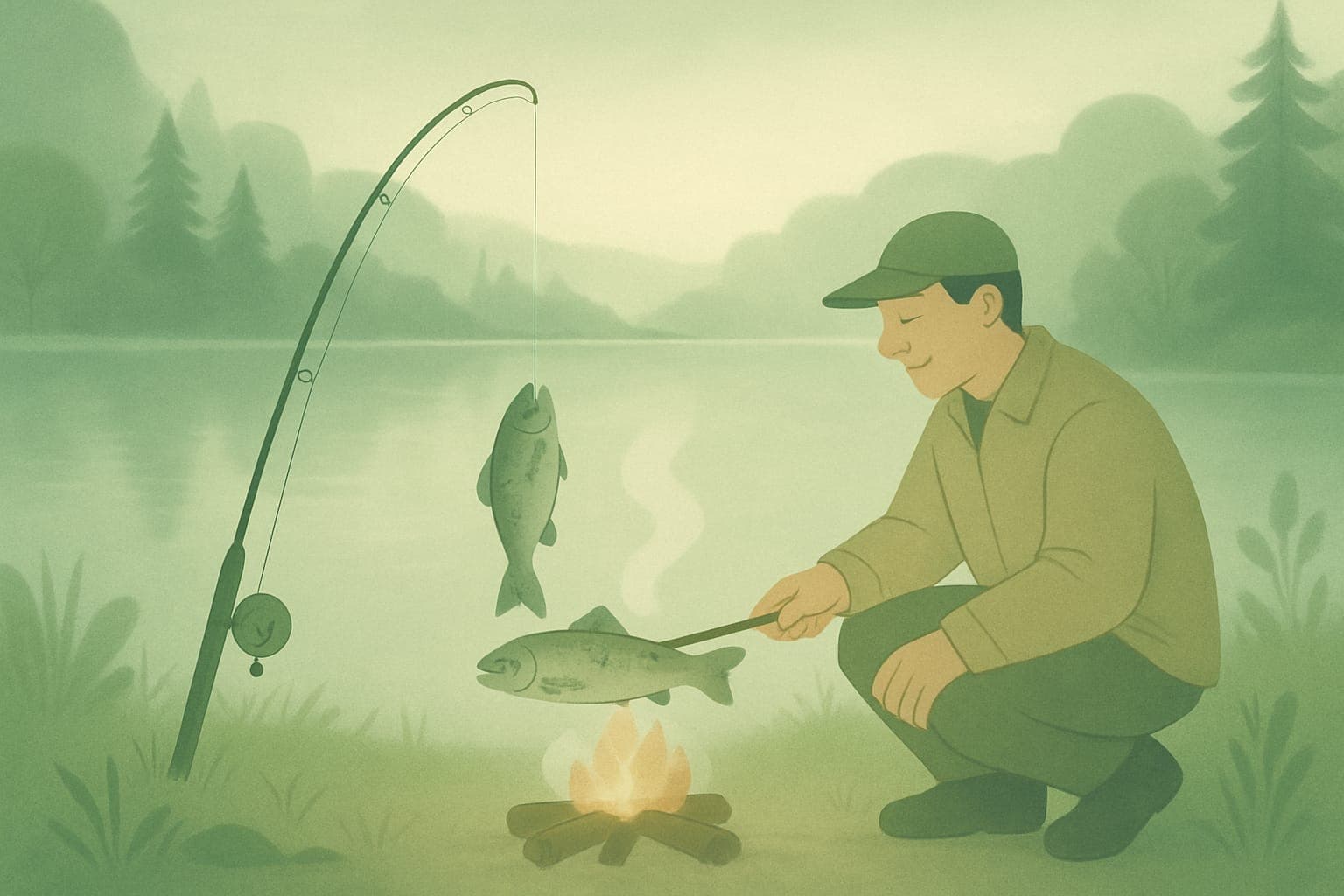
Waiting by the water without a clock, then handing the cook whatever came out. On patience as an ingredient, whole fish arriving in the kitchen, and the outdoor grill as a way of gathering people.
The freshest fish is not the one you buy well. It is the one you wait for. Catching your own dinner reverses the usual order of a meal: first the still water, the rod resting in your hand and a long stretch of time with no clock in it; then, and only then, the fire. In Quindío, where the larder is usually described in terms of coffee, plantain and mid-altitude fruit, a lake set among guadua bamboo is a quiet exception almost nobody counts on.
By mid-morning the water still holds the temperature of the night. The surface gives back the green of the bamboo that surrounds it, and when the wind crosses, that green breaks into sheets that take a moment to knit together again. You sit on the bank, cast, and understand immediately that there is nothing else to do. That is the entire set of instructions.
Patience is the first ingredient.
This is not a pretty phrase; it is a fairly technical description. Nothing that happens on the bank depends on the will of the person holding the rod. You choose the spot, the hour and the bait. The rest belongs to the fish and to the water. That small, almost domestic surrender is what begins to change the meal long before any meal exists.
For the first few minutes the mind is still elsewhere. It runs calculations, checks imaginary messages, works out how long this is going to take. Then the volume drops and the sounds that were there all along come forward: the dry creak of bamboo culms rubbing against each other, an invisible splash near the reeds, a bird repeating the same note as if correcting somebody. Waiting stops feeling like delay and becomes, without announcing itself, the point.
Catching your own dinner, unhurried.
The pull always arrives once you have stopped expecting it. The rod bends, your pulse changes gear and there are a few seconds of negotiation between arm and water. Landing a fish is less cinematic than films promise and more thrilling than anyone admits out loud. It is worth doing properly: wet hands before touching it, short movements, no animal mishandled for the sake of a photograph.
Then comes an old, simple rule: you catch what you are going to eat. At Cannatel the experience is called Pesca, and it ends where it should, in the kitchen. Whatever comes out of the lake you hand to the chef, and the chef cooks it. There is no cold store in between, no transport, no days in a refrigerator. The distance between water and fire is measured in footsteps.
In terms of flavour, that short distance is almost everything. A fish that has not travelled has firm, elastic flesh, smells of clean water and needs no sauce to hide behind. The skin crisps properly because it did not sweat out its moisture on the way. And the flesh lifts off the backbone in two whole fillets, which is the most honest way of knowing it was cooked well.
A whole fish also gives a cook information that a shrink-wrapped fillet has already lost: the clear eye, the gills still bright, the flesh that springs back under a finger. With all that in plain sight, the cooking turns brief. Salt, lime, a good fat, perhaps a few herbs from the garden. The embers do the rest.
Quindío eats more fish than it admits. Up in the mountains, on the road towards Salento and the Cocora Valley, trout has been on menus for decades: with garlic and butter, with mushrooms, or wrapped and set at the edge of the coals. In the warmer land towards the west of the department, whole mojarra is fried until the fins crackle and served with a wedge of lime. This is not port cooking. It is freshwater cooking, farm and pond cooking, living quietly alongside the coffee.
The table around it is the usual one, which is exactly why it works. Patacón, pressed and fried twice, white rice, thick slices of avocado, a hogao of tomato and spring onion cooked without hurry, and lime on the side for whoever wants it. None of it competes with the fish; all of it is there to carry it. Coffee-country cooking rarely asks the side dishes to be the story.
When there are several of you, the whole thing moves to the open-air grill, the BBQ in the language of the house, meant for groups and celebrations. A grill forces you to do what indoor kitchens prevent: cook in front of people, with people talking over you and offering opinions on the state of the coals.
Fire also manages time on its own terms. Nobody rushes an ember. You wait for the flame to drop and settle into that even heat, free of black smoke, that lets the fish sit down without sticking. In that interval the conversation arranges itself: someone drags a chair closer, someone reports on how the afternoon went, someone else volunteers to turn the thing that should not be turned yet.
And then the plate arrives, and with it the sentence that justifies the entire exercise: I caught this. Children say it with disproportionate, repeated pride. Adults say it once, more quietly, but they say it. It is the same old satisfaction of having brought something to the table.
Eating something whose origin you watched from beginning to end is rare in contemporary life. The whole chain fits inside one afternoon: the water, the wait, the knife, the fire, the plate. Nobody leaves converted into an angler or a cook, but an idea stays behind that is hard to switch off, which is that food comes from somewhere, and that somewhere has a smell, a temperature and a time of day.
If you are going to try it, two moments rule. The first hour of the morning, when the water is cold and the mist has not yet lifted off the bamboo, and the end of the afternoon, when the heat gives way and the surface starts moving again. Clothes you can get wet, repellent, a hat. And silence, which is the hard part: the bank rewards whoever talks least.
Afterwards, if there is light left, the ecological trail through the protected guadua forest is the natural continuation of the meal. Walking slowly with the taste of smoke still in your mouth, the bamboo closing overhead, is an efficient way to finish digesting the afternoon.
When night falls the lake goes dark before the sky does. The creak of the culms takes back the space the conversation had, the grill cools slowly, and what is left on the plates is a clean spine, a spent piece of lime and very little else. Nothing else is needed.