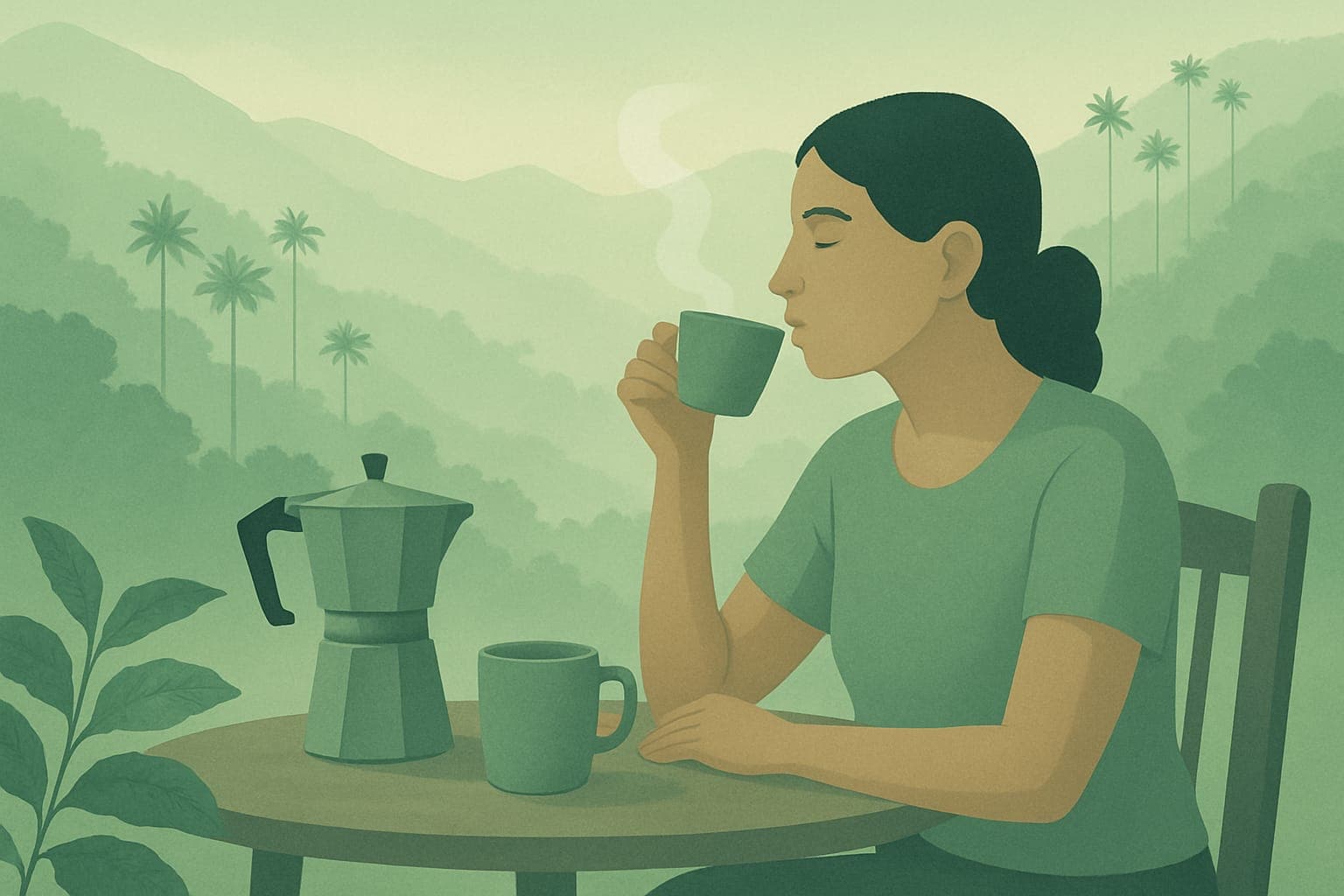
In coffee country, coffee isn't tasted — it's drunk. An honest guide to ordering, pouring and enjoying a cup in Quindío without protocol, following the habits that hold the table together from early on.
Coffee in Quindío does not begin at a tasting table, with aroma wheels and silver spoons. It begins in a kitchen that is still dark, with water heating and someone standing there, waiting. At that hour nobody mentions citrus notes or scores: it is poured, blown on and drunk, usually before the first complete sentence of the day.
Visitors who arrive in coffee country intending to learn how to taste tend to discover, on the first morning, that here coffee is above all a social habit. It is offered before anyone asks your name. It is drunk standing up, in a doorway, watching a wet street while the day gets decided. And that small detail is the hardest part to imitate.
The first tinto is not up for discussion.
A tinto is the small, hot, black coffee that carries the day in any town in the department. It appears in the corner shop, the hardware store, the waiting room, the middle of a business conversation. It isn't a product so much as a way of saying good morning, of taking a pause, of apologising, of closing a deal.
The unwritten rule is to accept it. You can ask for a small one, you can ask for it unsweetened, you can leave half of it; what you don't do is wave it away. On a coffee farm, the tinto the lady of the house hands you is the first part of the tour, even if nobody announces it that way and it appears on no itinerary.
A minimum vocabulary for ordering.
Three phrases cover almost everything. Un tinto is black coffee in a small cup. Un café con leche is what it sounds like, and usually arrives sweeter than you expect. And sin dulce — without sugar — is the phrase worth memorising, because across much of the region sugar or panela comes as standard, already dissolved in the pot.
This deserves saying without condescension: that sweetness is not a mistake of local culture. It comes from a time when the best beans were exported and what stayed home was what didn't grade, and from work that began before sunrise, when sugar was cheap fuel. Lighter roasts are common now, and plenty of houses serve it black. But if it arrives sweet, it arrives with history.
The olleta, the greca and the cloth strainer.
In Quindío homes coffee is made several ways, and none of them requires explanation. The olleta with its cloth strainer — a cotton sock that stains darker over the years and that nobody washes with soap — gives a clean, round cup with no edge to it. The greca in town cafés, switched on early, keeps tinto ready at any hour, and the last round never tastes like the first. In roasteries you find paper filters, scales and the word method.
None is better than the others; each answers a situation. The cloth strainer is for the house and the long conversation. The greca is for the street and the hurry. The filter is for when you want to hear where the bean came from. The one constant is that coffee is not served fully boiling. It rests a moment, because at that temperature the mouth registers nothing at all.
How to drink coffee in Quindío without ceremony.
The procedure, if it deserves the name, is short. Take the cup with both hands, because it will be hot. Smell it without pushing your nose in: steam says more from a distance. Take one short first sip and wait. If you are going to add sugar, add it after that sip and not before — it is the only way to know what you are correcting.
Then drink it. No swirling the cup, no loud slurping, no describing out loud what you feel. Coffee here holds that simplicity well: in a small cup, a well-made tinto carries panela sweetness, something of ripe fruit and a clean finish that argues for a second. And the second is the one that matters, because it arrives once nobody is watching the first.
The second cup belongs to the conversation. That is when the harvest gets discussed, and the rain, and the price, and the child who left to study. In coffee culture the coffee is not the subject; it is the excuse and the clock. When someone pours a third, the talking has turned serious.
Where, and at what hour.
The town squares are the best place to practise. Salento's Calle Real, early, before the craft shops open, when the painted balconies still hold the night's damp. Filandia's historic centre, with its bahareque houses, where coffee is drunk watching people go by. Pijao, the first town in Latin America admitted to Cittaslow, the international slow cities network — something you notice in the pace at which the cup reaches you. Buenavista, the balcony of Quindío, perched on the range among viewpoints and coffee farms that open their doors.
On the farms the scene changes. There coffee is drunk beside the depulping machine, next to the drying patios, with the smell of processing in the background. If a formal tasting is on offer, take it: it teaches you to name what you were already feeling. But do it after you have drunk coffee the other way, without instructions, so you have something to compare it to.
In Armenia, the departmental capital and the natural starting point for the rest of Quindío, you find house-roast bars and conversations about varieties and fermentations. It is a different register, equally legitimate. City and village drink the same bean in different ways, and both ways teach something worth knowing.
At Cannatel, among the guadua, the habit adapts to the house: brunch is served from seven to ten in the morning, and at that hour the cup usually ends up at one of the open-air co-working spots or on a bench along the ecological trail that crosses the protected bamboo forest. Coffee turns up in the spa too, in the Experiencia Moca, which puts the ground beans on the skin alongside chocolate — a use that local growers find both funny and intriguing.
In the end, drinking coffee in Quindío without ceremony gives nothing up. It means understanding that the ritual already existed and was simply another one: shorter, more frequent, more talkative. You learn it the moment you stop counting sips and accept the second tinto without asking the time.