Volcanic ash soils, hand picking and washing done with mountain water. What sets a Quindío cup apart, and how to cup it step by step, without mystique, while travelling the coffee region.
Quindío single origin coffee is not a marketing label or a menu flourish: it is the sum of one specific hillside, one variety somebody planted, one hand that chose the ripe cherry, and one washing done with cold mountain water. All of it arrives compressed into a cup that, served at breakfast on a farm near Armenia, looks perfectly ordinary. Learning to read that cup changes the whole trip: you stop drinking coffee and start understanding the landscape that made it.
Origin means being able to trace the path backwards. Not just the country, but the municipality, the farm, the plot, the position on the slope, the variety, and the way the bean was fermented and dried. When that chain is intact, the cup stops being an anonymous product and becomes a document. Quindío is an unusually good place to do this, because here coffee is never far away: it grows beside the road, behind the town, on the slope you can see from the lookout.
Geography explains much of the character. This is the western flank of the Central Andes, on deep, loose soils formed from volcanic ash that drain well and hold organic matter. Rainfall comes in two seasons, which gives the region a main harvest and a smaller one, the mitaca, so there is nearly always something flowering and something ripening on the same hillside. Many groves still grow under the shade of guamo and plantain trees, and that half-light slows ripening and lets the fruit build sugar.
Variety is the other half of the story. Old plantings of Caturra and Typica share the department with newer blocks of Castillo, Colombia and Tabí, chosen for their resistance to leaf rust. On smaller farms you sometimes find experimental rows of Bourbon or Geisha, planted by growers who bet on flavour rather than yield. Asking about the variety at the farm where you are having breakfast is, almost always, the beginning of a long and generous conversation.
Then comes processing, usually washed in Colombia, and this is where most of what you will taste gets decided. Selective picking, cherry by cherry, red fruit only. Pulping the same day. Fermenting in a tank for a matter of hours, until the mucilage lets go. Washing, and then slow drying in plastic-covered patios or in wooden drawers that slide out into the sun and slide back when the rain arrives. That method is why the region's coffees taste clean and why their acidity has such clarity.
What makes a cup of Quindío single origin coffee distinct. Generalising is always unfair, but there is a family resemblance: the sweetness of panela and caramel, a citric acidity closer to mandarin than to lemon, a medium silky body, and a cocoa or walnut finish that lingers. Well-processed microlots break the mould and show floral notes, tropical fruit or red berries. What rarely goes missing is balance. This is coffee that does not shout.
Roasting can confirm or erase everything above. A very dark roast flattens any origin into a single burnt flavour, and for decades that was the coffee that stayed in the country while the good lots were exported. That has changed. Small roasters now work in Armenia, in the painted centre of Filandia and along the Calle Real in Salento, aiming at medium roasts that let the farm come through. Look for them, and ask for the roast date rather than the expiry date.
How to cup, without the mystique. Professional cupping exists to compare coffees on equal terms, and its protocol is simpler than it looks. The coffee is ground a little coarser than for filter, the same amount goes into each cup, and hot water — not boiling — is poured over all of them. That is all. No filter, no brewing method, no barista in between: just coffee, water and the person tasting.
The first step happens before the water. You bring your nose to the dry grounds and smell: this is fragrance, usually the sweetest and most fruity moment of the whole session, and worth taking slowly. Then the water goes in and the coffee sits. A crust forms on the surface while the wet aroma builds underneath, different from the dry one and often deeper.
Then you break the crust. With a spoon you push the floating layer back, three times, nose close to the cup, while the steam rises. That instant carries almost all the aromatic information the coffee has, and for many tasters it is the best part of the job. Afterwards you skim off the foam and the grounds with two spoons, and you wait for the cup to cool.
You taste by slurping hard, so the liquid sprays across the palate and reaches the back of the nose. It sounds inelegant and it is exactly right. You taste several times as the coffee cools: a cup can seem flat when it is very hot and reveal all its fruit when it is merely warm. Cooling is when a coffee shows its faults and also its best qualities.
What you are judging stays constant: acidity, which should be lively rather than sharp; body, which is texture and not strength; sweetness, which holds everything else up; the balance among those parts; and the aftertaste, what remains once the cup is gone. Writing helps more than remembering. Two or three words per cup are enough at the start.
Vocabulary is built from what you already know. There is no need to say red berries if what you actually recognise is guava, raw cane sugar, dark drinking chocolate or mandarin. Flavour wheels work as maps, but the best training is domestic: smell the fruit before you eat it, smell the panela, smell the cocoa. Cupping is olfactory memory, and memory is trained in the kitchen.
For practice, the whole department works as a classroom. In Buenavista, the balcony of Quindío, coffee farms perched on the range open their doors and show the entire process. In Pijao, the first Latin American town admitted to the Cittaslow network of slow cities, coffee is unhurried by definition. Filandia and Salento keep specialty cafés steps away from their bahareque houses, and the Parque del Café, between Montenegro and Pueblo Tapao, tells the long story of the bean in one place.
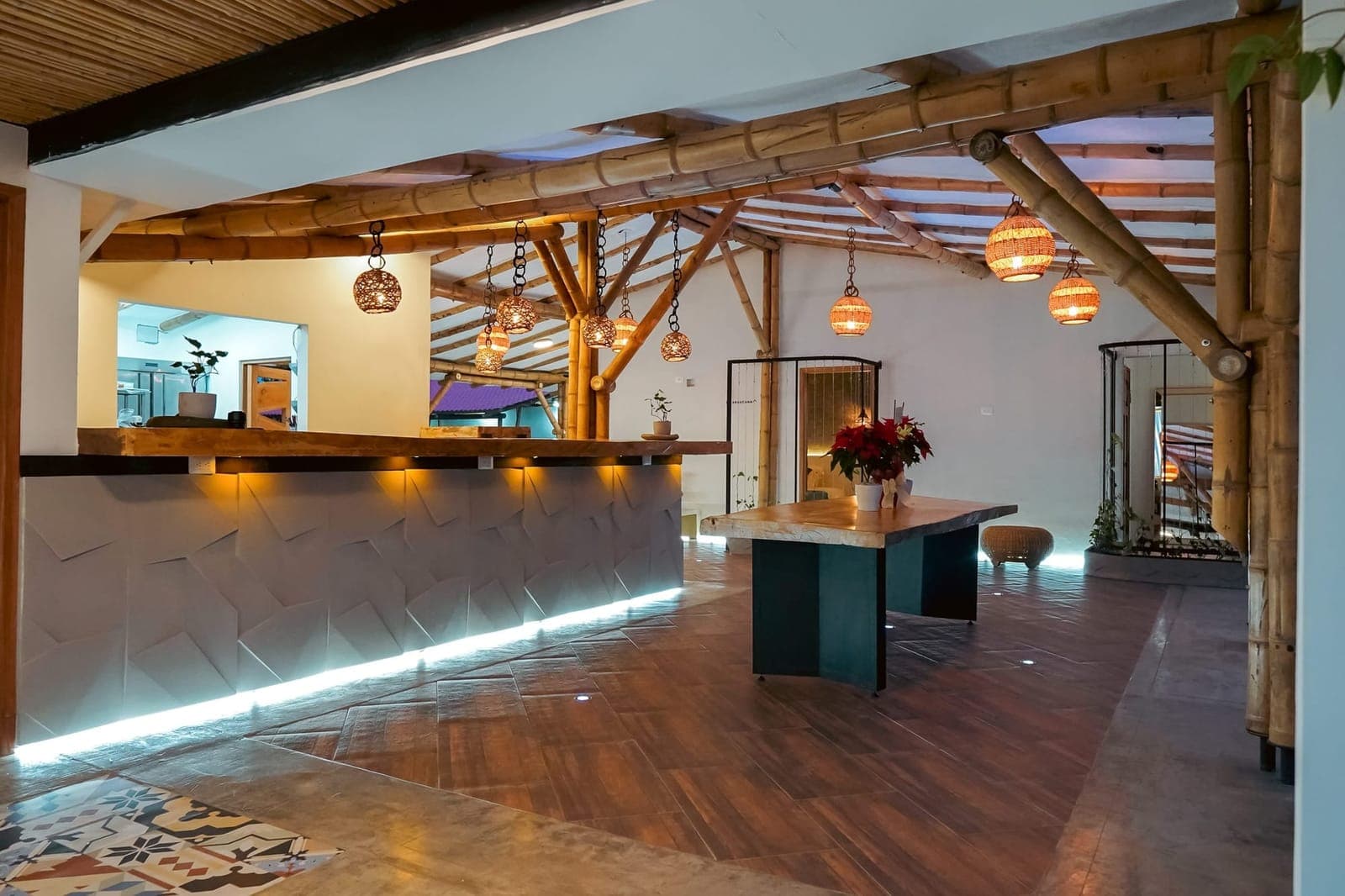
At Cannatel the reading begins earlier and closer to home. The first cup of the morning is drunk with the bamboo forest still damp in front of you, and that silence makes a good laboratory: without noise, the nose works better. Afterwards, the two kilometres of ecological trail through protected guadua make a good interval between one cup and the next, or between a working morning with fibre WiFi and the bamboo behind you and the rest of the day.
In the end, cupping is not a connoisseur's gesture but an act of attention. When you buy coffee before leaving, ask for the farm, the variety, the process and the roast date; buy whole beans and grind them at home. For a few weeks, that bag will be the most accurate way to return to Quindío.