Salento, Filandia, Pijao, Buenavista. An unhurried way to travel the Quindío towns over two days, choosing the right hour for each plaza and leaving room to return to the bamboo before dark.
There is a way of travelling the Quindío towns that will not fit into a checklist. It does not belong to the visitor who wants to see everything between Friday and Sunday, but to the one who picks three or four plazas, sits down in each of them and lets the day arrange itself. The department is small and its roads run through coffee fields, bamboo and curves that force you to slow down — which sounds like a logistical detail and is, in fact, half of the journey.
From Cannatel, among the guadua forests of Armenia, almost everything is close. The same road that passes in front of the hotel leads to the departmental capital, and from there the routes open north and south. It helps to think of the weekend as two directions rather than one loop: Salento and Filandia to the north, Pijao and Buenavista to the south. Trying to join them all in a single day is the surest way to see none of them.
A workable order for the Quindío towns
The first decision is not which town but at what hour. Coffee-country plazas wake before their visitors: the first small black coffees are poured while mist still sits on the hills, wooden doors open one by one, and the loudest sound is a chair being carried out to the pavement. That hour is short. By midday the buses arrive and the same place changes its temperature and its conversation.
So the order that works is simple: start early in the town that receives the most people, and save for late afternoon the one that rewards low light. If Saturday begins in Salento, it can end in Filandia. If Sunday begins in Buenavista, it can settle in Pijao, where hurry was never considered a virtue.
Salento, and the end of the Calle Real
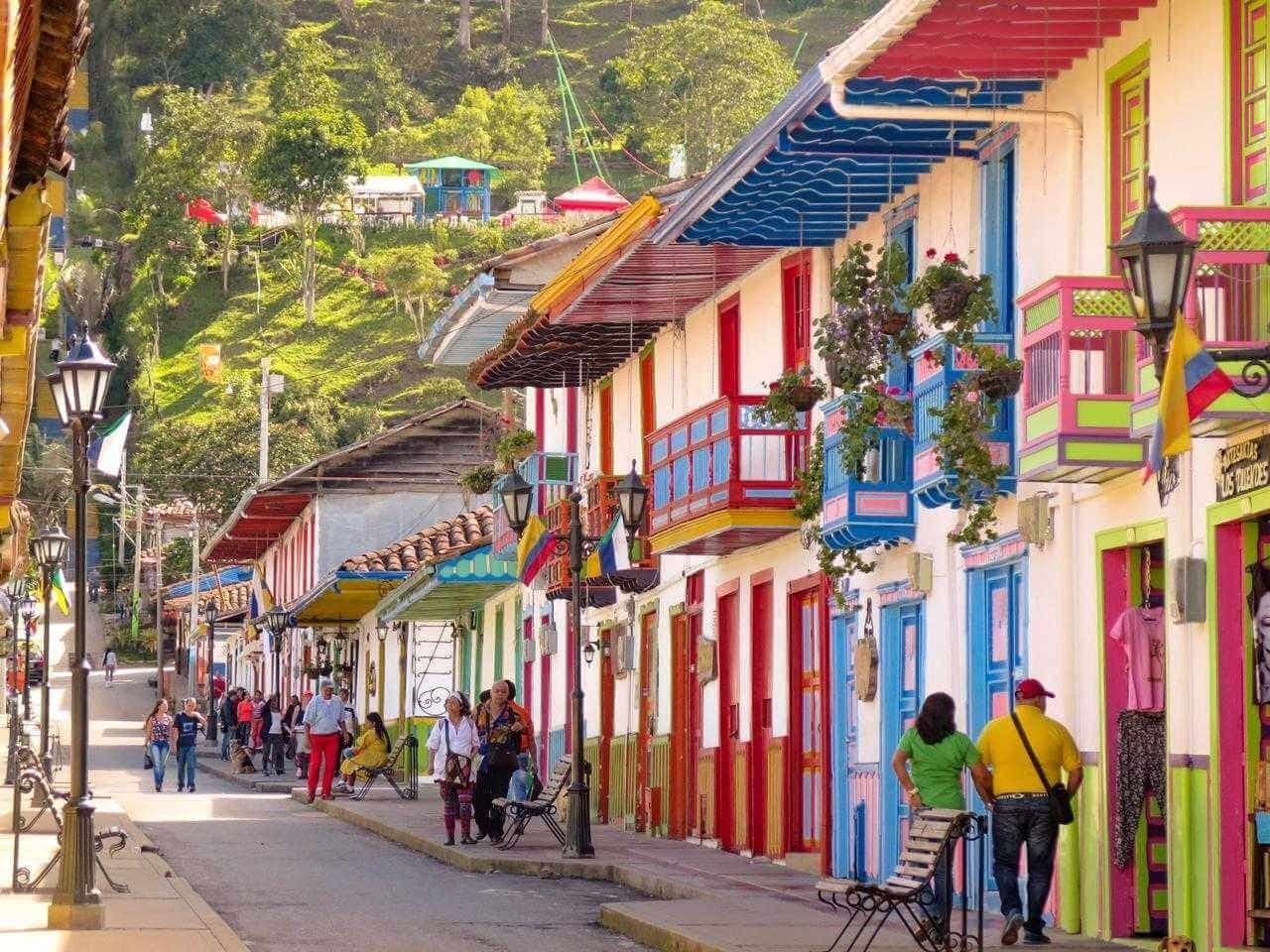
Salento is the oldest municipality in Quindío and the Calle Real shows it: painted balconies, the architecture of the Antioquian colonisation, crafts and cafés facing each other across the street. Walking it early is a different proposition altogether. Stalls are still being assembled, the smell of old paint and damp timber is still there, and you can walk down the middle of the road without weaving around anyone.
Where the Calle Real ends, a flight of steps climbs to the Alto de la Cruz. The ascent is short and honest, and at the top the valley of the Quindío river opens out. On clear days the mountains of Los Nevados appear behind it; on misty days something equally good happens — the town keeps disappearing into the cloud and coming back.
Nearby lies the Valle de Cocora, where the wax palm of Quindío, Colombia's national tree, rises as high as sixty metres above the valley floor. Trails and lookouts run along the foothills of Los Nevados, and they change character by the hour: quiet and grey first thing, green and wide open once the sun gets through. Go with footwear that does not mind mud, and with the intention of walking slowly, which is the only way the palms really register.
Filandia, for the last light
Filandia is best kept for the afternoon. Its bahareque houses, painted in strong colours, form one of the best preserved pieces of coffee architecture in the department, and the plaza has that quality of places where people still sit down simply to watch. Around it there are workshops, small cafés and balconies from which the whole town passes by in ten minutes.
Just outside stands the Mirador Colina Iluminada, a nineteen-metre wooden tower that opens a three-hundred-and-sixty-degree view over the valleys of Quindío and Risaralda. Climbing it as the sun drops has something ceremonial about it: the air cools, the ranges sort themselves into layers, and the landscape stops looking like a postcard and becomes geography.
South: Pijao and Buenavista
Sunday can go the other way. Pijao was the first municipality in Latin America admitted to Cittaslow, the international network of slow cities, and the title suits it. It is not a town you visit; it is a town you stay in for a while. A plaza framed by mountains, façades in deep colours, and the clear sense that nobody is going to rush anybody. It is made for a long breakfast and a conversation with no clock in it.
Buenavista is the balcony of Quindío. The smallest municipality in the department sits perched on the cordillera, among lookouts and coffee farms that open their doors. From up there the shape of the territory becomes legible: coffee descending in bands, bamboo marking the streams, the valley widening to the west. A cup of coffee drunk in front of that carries a different weight.
Armenia, in between
Armenia is often reduced to a place you drive through, which is a pleasant mistake to correct. The departmental capital is home to the Museo del Oro Quimbaya and the natural starting point for the whole of Quindío. A rainy afternoon — and rain here arrives without warning — is well spent among goldwork that has been telling, for centuries, who lived in these mountains before coffee did.
If the weekend includes children, the Parque del Café, between Montenegro and Pueblo Tapao, changes the rhythm completely: rides, a cable car and the coffee world explained in one place. It is a different kind of day from the plazas, and it is better not to mix the two.
Coming back before dark
What one appreciates most about a weekend among the Quindío towns is the return. Getting back while there is still light, leaving the car where it is and walking the two kilometres of the ecological trail through protected bamboo, when the stalks creak and the afternoon fades between the leaves. After that, whatever the body asks for: a massage, a film in the open air, a round of tejo, or dinner that began with a line cast into the lake.
You do not need to see six towns. You need to see two properly, and keep the rest for next time — the only reasonable promise a territory like this can make to the people who visit it.