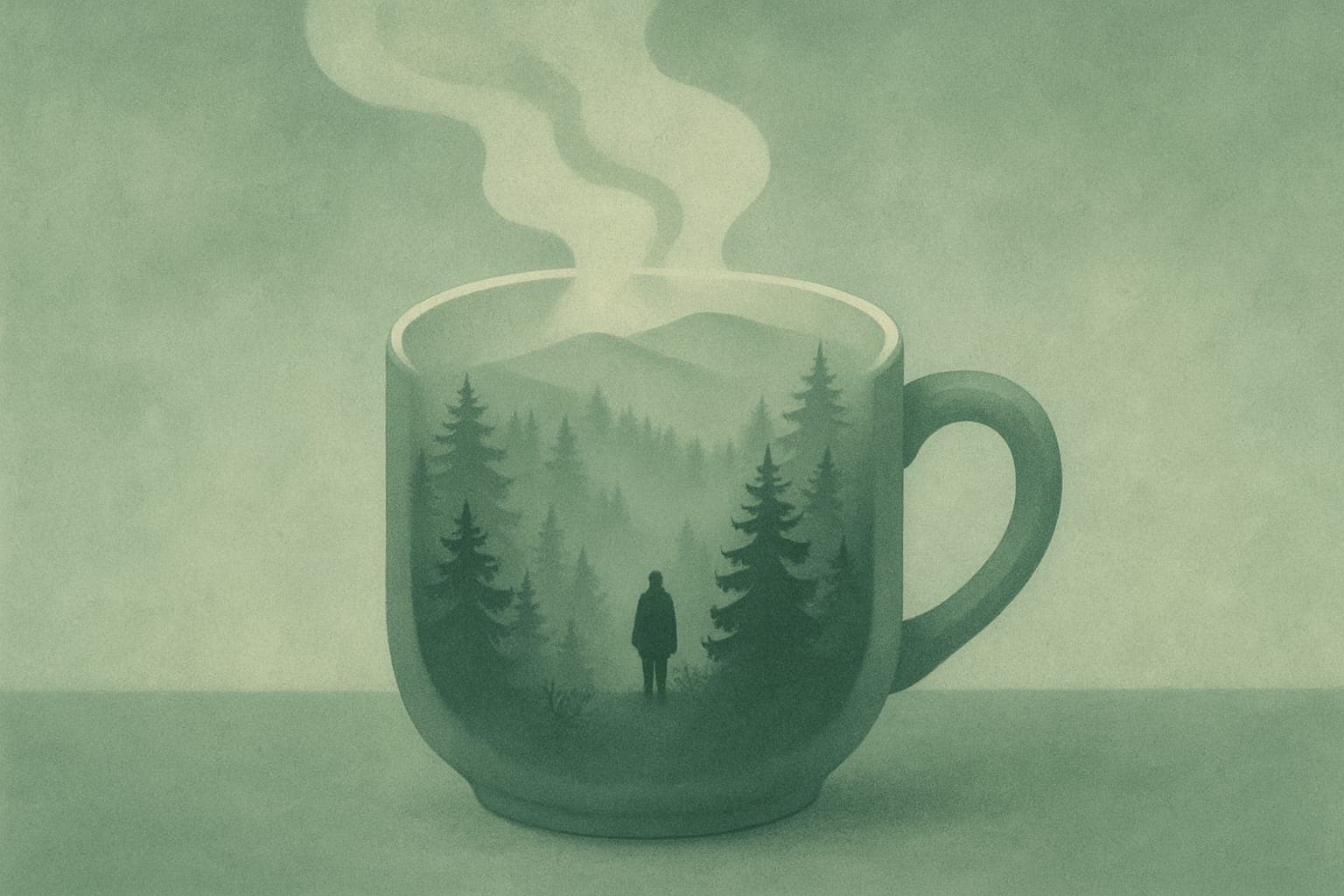
Shade trees, steep slopes, volcanic ash and the mist that climbs the hillside after noon. Each element of Quindío's coffee landscape has a translation in the cup: how to read it, and where to see it up close.
By mid-afternoon the mist climbs the hillside as though something were pushing it up from the river. It erases the valley floor first, then the rows of coffee, and finally leaves only the guamo trees standing, dark and still, holding up a low ceiling of cloud. That is how Quindío's coffee landscape assembles itself on almost any given day.
This punctual cloud is not picturesque scenery. It is a growing condition. And like every growing condition, it ends up on the palate of whoever drinks.
The premise is simple, if a little bold: nearly everything visible from a lookout — the gradient, the tall shade trees, the colour of turned soil, the hour the fog arrives — has a liquid translation. Recognising it takes no technical vocabulary. It takes looking at a hillside with the same attention you give to freshly ground coffee.
The coffee landscape begins in the shade
The first thing that organises a planted slope here is the trees that produce no coffee at all. Guamos above all, with their wide, light canopies built to filter sun; also walnut, plantain, the occasional cámbulo in scarlet bloom. They are there for shade, and shade works on several fronts at once.
It lowers the temperature of the crop and, with it, the plant's hurry. Fruit ripens more slowly, and a bean that takes longer to fill accumulates sugars without panic. You meet that later as a cleaner acidity, closer to fruit than to vinegar, and as a sweetness that does not vanish the moment you swallow.
Shade also manufactures soil. Leaf litter from the guamos breaks down, feeds the ground and holds moisture through the dry months. And the roots hold the slope itself: without them, a single hard downpour would carry away what took centuries to build.
Gradient is the second signature. In Quindío coffee grows on hillsides no machine can enter, and that limitation became a virtue: it is picked by hand, cherry by cherry, with pickers returning to the same plant as the next ones ripen. A cup without astringency is rarely luck; it usually means the green cherries were left on the tree.
Underneath everything lies the soil — volcanic ash from the cordillera, young, loose and deep, able to hold water without drowning the root. It is unforgiving ground that gives a great deal in return, chiefly body: that sense of weight and texture felt in the middle of the tongue before any aroma registers.
Mist as a thermostat
The afternoon fog acts as a parasol over the whole slope. It cuts the sun at its harshest and brings the coolness of night forward by hours. Between midday and dawn there is a swing in temperature that the plant both feels and exploits: at night it spends less than it produced by day, and the difference stays stored in the bean.
The flip side is constant humidity. In a climate like this, drying coffee is a craft rather than a formality. Hence the marquesinas, translucent roofs where parchment is spread, raked and turned, losing moisture slowly, sheltered from squalls that arrive without warning.
Slow, even drying is what allows a coffee to keep its character for months. A rushed one looks beautiful and fades in weeks. The difference is never in the aroma of the first day, only in the last.
From mountain water to drying floor
Between picking and drying comes one short, decisive step. The cherry is pulped, the mucilage ferments in tanks, and the beans are washed with cold stream water brought down from the mountains. Cold lengthens the fermentation and takes the nervousness out of it, giving sugars time to dissolve before overripe flavours appear.
Water is the thing people here mention first when defending their coffee. It is not folklore. A wash in clean, cold water is the main reason a cup feels transparent, with flavours standing apart from one another rather than piled together.
How to taste a landscape
No laboratory table required. Grind it on the spot, smell the dry powder and stay with it a few seconds: raw cane sugar appears, orange peel, sometimes something floral. Then hot water, the crust that forms on top, and a second aroma rounder and sweeter than the first.
When you sip, attend to three things and resist naming everything. Whether the acidity is pleasant or sharp. Whether the liquid feels light as tea or dense as broth. And whether the flavour grows after swallowing or shuts off at once. A shaded hillside coffee tends to grow.
That closes the circuit. The gradient shows up as clarity, the shade as sweetness, the volcanic ash as body, the mist as an acidity that does not bite. The entire landscape fits into one mouthful, and it can be repeated.
Lookouts where the landscape explains itself
Buenavista is the best place to take it in at once. They call it the balcony of Quindío: the smallest municipality in the department, perched on the ridge, with viewpoints that drop over a sea of planted slopes and coffee farms that open their doors to anyone wanting to follow the process end to end.
Pijao offers a different scale. A coffee town among mountains, it was the first municipality in Latin America admitted to Cittaslow, the international network of slow cities. It is a good place to confirm that the rhythm of the crop and the rhythm of the people who grow it are one and the same.
In Filandia, the Colina Iluminada lookout — a nineteen-metre timber tower on the edge of town — opens a 360-degree view over the valleys of Quindío and Risaralda. From up there the pattern becomes legible: bamboo in the ravines, coffee across the mid-slopes, pasture on the tops. Below, the painted bahareque houses of the old centre are the built version of the same economy.
Salento closes the map at the upper edge. Where the Calle Real ends, a flight of steps climbs to the Alto de la Cruz, and from there it is clear where coffee stops and something else begins: above lies the Cocora valley, where the wax palm rises as high as sixty metres. For anyone who prefers the story told in one place, the Parque del Café, between Montenegro and Pueblo Tapao, lays out the coffee world whole.
Guadua, the tree you don't drink
One element almost never makes it onto a label. In the ravines where coffee will not prosper, guadua bamboo grows, and that bamboo stand regulates water for the entire slope: it slows runoff, holds the banks, keeps cool the air that later drifts up through the coffee rows. No farm in Quindío works without its strip of guadua.
Walking through one helps explain what is in the cup. At Cannatel, two kilometres of ecological trail cross protected guadua forest: the creak of the culms, the dripping, the light filtered green. It is the same mechanism as shade, at another scale and without fruit.
Late in the day the mist slides back towards the river and the valley returns in pieces. It is the hour of the last coffee, usually the best one. You drink it looking at exactly what you are drinking, and for a moment it stops feeling like a metaphor.