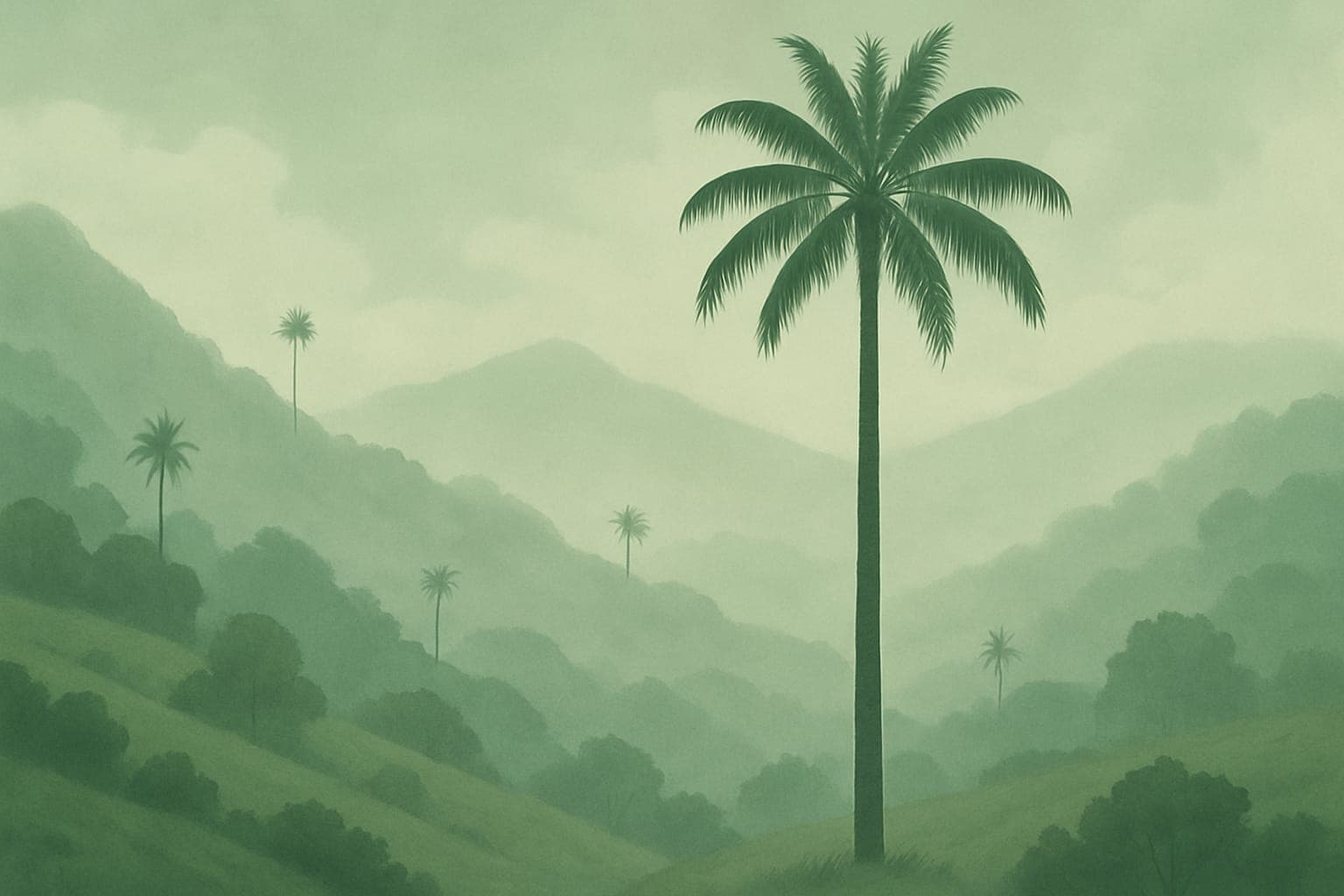
In the Cocora Valley the Quindío wax palm, Colombia's national tree, rises up to sixty metres above the pasture. What to look for on the foothills of Los Nevados when the mist decides to lift.
There is a moment, coming up from Salento, when the eye simply stops working. The road bends, the pasture opens, and there it is: the Quindío wax palm, Colombia's national tree, rising up to sixty metres above the grass on a trunk so slender it looks like a miscalculation. The issue isn't that the tree is tall. The issue is that it is out of scale with everything else in the landscape.
The brain reads size by comparison, and in Cocora it runs out of references. A big lowland tree makes sense because it spreads: branches, canopy, shade, width matching height. The wax palm occupies nothing. It goes straight up without branching, and only at the very top opens a crown of fronds that, from below, looks small — almost ornamental. You look at a cow standing at the base, then at the crown, and the arithmetic refuses to close.
Mist helps and hinders in equal measure. When it drops, it erases the ridgelines and leaves the trunks disappearing into white with no visible ending, which is probably the truest image of the valley. When it lifts — and it lifts suddenly, in under a minute — the background arrives: the foothills of Los Nevados, the dark edge of the cloud forest, palms scattered across the pasture as though someone had planted them one at a time.
What the wax palm actually is
Ceroxylon quindiuense is the scientific name, and the second half of it is no accident: the department gave the species its name. This is a mountain palm, adapted to the cold, permanently damp air of the Andean cloud forest, where almost no other palm thrives. Its trunk is coated in a whitish waxy layer that protects it from that humidity, and for a long time the wax was scraped off to make candles and soap. Hence the name.
Its young fronds were also cut for Palm Sunday, a custom that took the whole juvenile palm with it. Much of the species' recent history is the history of learning not to cut it: its designation as the national tree, the protection of the valley, and the slow work of communities in Salento and the surrounding towns to turn the palm back from raw material into landscape.
Get close to a trunk and it rewards you. The surface is ringed with horizontal scars left by fronds that fell long ago, and older trunks are inhabited: mosses, lichens, bromeliads and ferns settle into the ridges and turn each column into a vertical habitat of its own. None of this is visible from the viewpoint. You have to reach the base and look up.
The other thing worth understanding is that the palms standing alone in the pasture are alone for a reason. They did not grow in open grass; they grew in forest, and the forest went. They are the survivors of an old clearing, adults left standing because felling them yielded no useful timber. The seed needs shade and covered ground to germinate, and where cattle graze the seedling rarely survives its first year. So the most spectacular palms in Cocora are also the most static: a forest you can see whole, but one that isn't replacing itself unaided.
That explains the fenced enclosures you cross along the way, the patches of young regrowth, the stretches of pasture being handed back to the mountain. It also explains why it's worth staying on the path rather than cutting across the grass.
The yellow-eared parrot is the other character in this story. It nests in old wax palms, in cavities high up the trunk, and its fate has been tied to theirs: no mature palms, no nest sites. Seeing one is never guaranteed, but hearing one often is — a metallic call crossing the valley before you can locate the flock. When it happens, stop walking and look up.
Walking the valley is not one single thing. Trails and viewpoints run across the foothills: short routes that stay in the open pasture among palms and cattle, and longer ones that enter the cloud forest, cross the river on hanging bridges and climb until the air feels different. The classic version is done as a loop — up through the forest, down through the open valley — which leaves the palms for the end, when the morning light is finally working in your favour.
The hour matters more than the forecast. Early, the valley is either clear or fogged in, but it is quiet, and the palms stand with nobody at their feet. Towards midday the cloud climbs from the valley floor and tends to settle. Afternoons bring rain more often than sun, and the mud it leaves does not dry overnight. Boots or shoes you don't mind ruining, a waterproof layer and something warm: however bright it looks leaving Armenia, Cocora runs on mountain air.
Cocora has the advantage of good company. Salento's Calle Real — coloured balconies, the architecture of the Antioquian colonisation, crafts and coffee from one pavement to the other — is the natural gateway, and where the street ends a staircase climbs to the Alto de la Cruz, with the Quindío river valley below and, on clear days, the line of Los Nevados behind it. Filandia, with its historic centre of painted bahareque houses, and the Colina Iluminada viewpoint, a nineteen-metre timber tower with a three-hundred-and-sixty-degree view over the valleys of Quindío and Risaralda, offer a different reading of the same range.
Back among the guadua, the comparison makes itself. Bamboo and wax palm are opposite answers to the same problem: how to get up there. Guadua does it fast, hollow, in colonies, leaning on its neighbours and creaking in the wind. The palm does it alone and slowly, one ring at a time, over more life than a visitor can accompany. Walking the two kilometres of ecological trail through protected guadua forest after a day in Cocora makes that difference physical: there you look up, here you walk inside.
In the end, the wax palm impresses less by height than by proportion. It is a tree that forces you to correct the scale you had been using to read the Quindío, and that correction lasts longer than the photograph. You come back to the room, look at the bamboo from the window, and still misjudge the distances. That is a good sign.